Hardness Testing Machines · Canan Testing
Providing you the best range of hardness testing machines: Rockwell hardness testers, Brinell hardness testers, Vickers and micro Vickers hardness testers, Rockwell cum superficial and Rockwell cum Brinell testers, and digital, touchscreen and fully computerised models, together with genuine spares such as diamond indenters, ball indenters and test blocks.
As a hardness tester supplier in India and authorised dealer of FIE, we help you choose the right method for your material, install the machine and calibrate it in our NABL accredited laboratory. Contact us for FIE Rockwell, Vickers and micro hardness machines, test blocks, indenters and calibration of Rockwell and Brinell machines.
Choose a type to see every model with features, datasheets and an instant enquiry option.
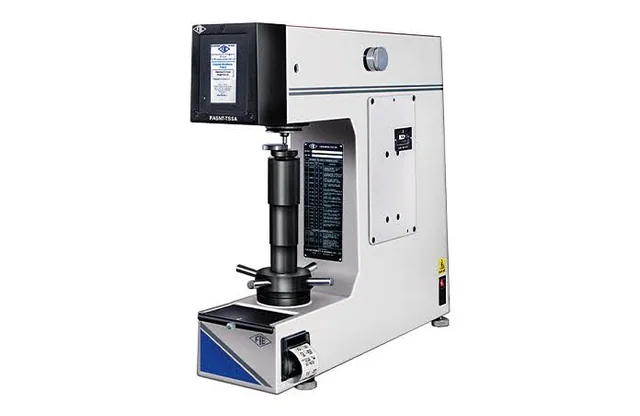
Rockwell hardness testing machines and testers: analogue, digital, touchscreen and portable models (RAS, RASN, RASNE, PR1). Get a quote.
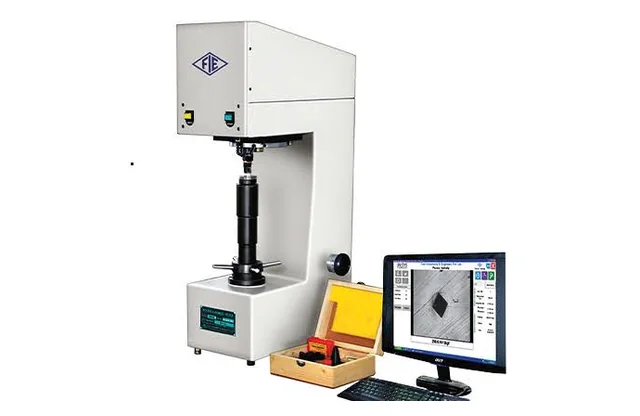
Brinell hardness tester machines: hydraulic, optical, computerised and load cell based models up to 3000 kgf. Spares, calibration and quote.
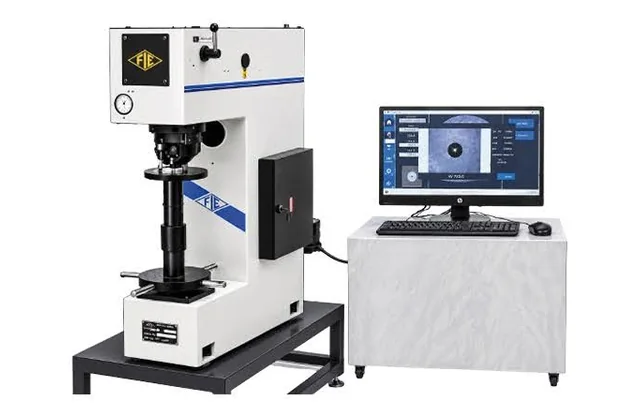
Vickers hardness testing machines and testers: basic, computerised and touchscreen VM 50 models, 5 to 50 kgf. Check specs and get a quote.
Know the machine
A hardness testing machine measures how strongly a material resists permanent indentation. A diamond or ball indenter is pressed into the surface under a controlled test force, and the size or depth of the impression is converted into a hardness number such as HRC, HB or HV. Because hardness correlates with strength, wear resistance and the success of heat treatment, it is the quickest and most widely used quality check for metal parts.
The right tester depends on your material and part. Rockwell testers give a direct reading in seconds and suit hardened steel parts. Brinell testers use a large ball and high load to average out coarse structures in castings and forgings. Vickers and micro Vickers testers use a diamond pyramid for thin sections, coatings and case depth.
| Method | Indenter | Typical loads | Best for |
|---|---|---|---|
| Rockwell | Diamond cone or steel ball | 60, 100, 150 kgf (superficial 15, 30, 45 kgf) | Fast production testing of heat-treated steel, finished parts |
| Brinell | Hardened steel / carbide ball | 250 to 3000 kgf | Castings, forgings, coarse-grained and non-ferrous metals |
| Vickers | Diamond pyramid | 1 to 50 kgf | Thin sections, case depth, wide hardness range |
| Micro Vickers | Diamond pyramid | 10 gf to 1000 gf | Thin sheets, coatings, small parts, microstructure |
Analogue (manual) testers such as the RAS and RASN series are economical and robust, ideal for workshops and teaching labs. Digital testers like the RAS D series remove dial-reading errors. Touchscreen and computerised testers store results, convert scales and print reports, while fully automatic machines such as the RASN TSFA and B-3000 TSFA remove operator influence entirely, which is valuable in production.
Complete range: Rockwell, Brinell, Vickers and micro Vickers testers from manual to fully automatic, plus large-component Brinmax machines.
Genuine FIE, Saroj and Diamond Tools machines with factory warranty and support.
The first company in India accredited by NABL for calibration of material testing machines.
Our own engineers install, commission and train your operators, then service the machine for life.
Indenters, test blocks, grips and wear parts from ready stock for quick replacement.
Head office in New Delhi, 6 regional offices and 5 more offices across India.
Trusted by automotive, steel and engineering majors, IITs, NITs and test laboratories.
Listed for guidance. Confirm the exact standard and edition required by your customer or specification.
A hardness testing machine presses an indenter into a material under a defined load and measures the depth or size of the impression. The result is expressed as a hardness number such as HRC, HB or HV, which indicates the resistance of the material to permanent deformation.
Rockwell measures indentation depth and gives a direct reading, so it is fastest. Brinell uses a large ball and high load, giving an average over coarse structures such as castings. Vickers uses a diamond pyramid and measures the diagonals, covering a very wide hardness range and thin sections.
A Brinell hardness tester is usually preferred because the large ball impression averages out coarse grain structures. For very large parts, a moving head or bridge type Brinell machine is used.
Yes. We stock diamond and ball indenters and Rockwell, Brinell and Vickers test blocks calibrated by an NABL accredited laboratory. See diamond indenters and hardness test blocks.
Yes. We calibrate Rockwell, Brinell and Vickers hardness testers of all makes on site, as per ISO 6508-2, ISO 6506-2 and ISO 6507-2, with an NABL accredited calibration certificate.
 Products
 Contact
 Call